
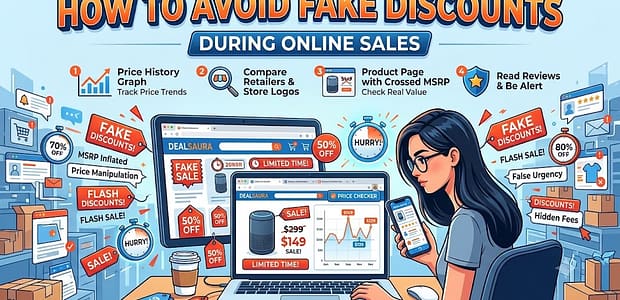

Online shopping festivals such as Amazon Great Indian Festival, Flipkart Big Billion Days, festive sales, and year-round flash deals offer shoppers incredible opportunities to save money. However, not every “50% OFF” or “80% Discount” banner represents a genuine bargain. Many online stores use pricing tricks, inflated original prices, and misleading promotions to make discounts appear larger than they actually are.
Being a smart shopper means looking beyond the percentage displayed on the product page. This guide explains how fake discounts work and how you can avoid falling for them.
What Are Fake Discounts?
A fake discount occurs when a retailer advertises an attractive price reduction that doesn’t represent real savings. Some common examples include:
- Increasing the product price just before a sale.
- Showing an inflated “Original Price” (MRP).
- Claiming “Limited Time Offer” when the same price is available regularly.
- Using countdown timers that automatically reset.
- Advertising huge discounts on low-quality or counterfeit products.
These tactics create urgency and encourage impulse buying instead of informed purchasing. Experts consistently recommend verifying prices and being cautious of urgency-based marketing and unrealistic markdowns.
1. Check the Product’s Price History
The easiest way to identify a fake discount is by checking how much the product has cost over the past few months.
Many products temporarily increase in price before major sales only to return to their normal selling price with a “discount.”
Price tracking websites and browser extensions allow you to view historical pricing, helping you determine whether the advertised deal is truly worth it.
If the “sale price” matches the product’s usual selling price, you’re not getting a real bargain.
2. Compare Prices Across Multiple Websites
Never purchase a product from the first website you visit.
Compare prices across multiple online marketplaces such as:
- Amazon
- Flipkart
- Croma
- Reliance Digital
- Vijay Sales
- Brand Official Stores
Many retailers compete on pricing, and you’ll often discover a better offer elsewhere.
3. Ignore Huge Percentage Discounts
A product advertised as:
- 70% OFF
- 80% OFF
- 90% OFF
doesn’t automatically mean it’s cheap.
Always focus on:
- Final selling price
- Product quality
- Warranty
- Seller reputation
An item priced at ₹2,999 after an “80% discount” could still be more expensive than another retailer selling the same product for ₹2,399 without flashy marketing.
4. Beware of Fake Countdown Timers
Many websites display messages such as:
- Only 2 minutes left!
- Sale ending today!
- Last 3 items remaining!
Refreshing the page often restarts the timer.
These urgency tactics are designed to pressure customers into making quick decisions instead of comparing prices. Artificial scarcity and countdown timers are common persuasive techniques used in misleading promotions.
5. Verify the Seller
Marketplaces allow thousands of independent sellers.
Before purchasing:
- Check seller ratings.
- Read customer reviews.
- Verify return policies.
- Look for verified or trusted seller badges.
Sometimes the cheapest listing comes from an unreliable seller offering counterfeit or damaged products.
6. Read Real Customer Reviews
Don’t rely solely on product ratings.
Instead:
- Read detailed reviews.
- Look at customer-uploaded photos.
- Check recent feedback.
- Filter negative reviews.
If multiple buyers mention fake products, delayed delivery, or misleading pricing, consider buying elsewhere.
7. Watch for Inflated MRP
Some retailers display:
MRP: ₹9,999
Sale Price: ₹4,999
The product may have never sold for ₹9,999.
Instead of comparing the sale price with the MRP, compare it with current market prices across several retailers.
8. Don’t Fall for “Buy More to Save More”
Offers such as:
- Buy 2 Get 1 Free
- Spend ₹5,000 and Save ₹500
- Buy 3 for Extra Discount
can increase your spending unnecessarily.
Ask yourself:
Would I still buy these items if there were no offer?
If the answer is no, the “discount” is actually costing you money.
9. Use Trusted Coupon Websites
Before completing your purchase, search for:
- Coupon codes
- Cashback offers
- Bank discounts
- Reward points
Combining genuine coupons with sale prices can provide real savings without paying inflated prices.
10. Be Careful with Fake Shopping Websites
Fraudulent websites often advertise unbelievable discounts on branded products.
Warning signs include:
- Poor website design
- Missing contact information
- No customer support
- Only prepaid payment options
- Strange domain names
- Unrealistic prices
If something feels suspicious, it’s safer to avoid the purchase. Fake stores frequently use copied branding, deep discounts, and urgency to steal payment details or personal information.
Smart Shopping Tips
Before placing an order:
✅ Compare prices on multiple websites.
✅ Check historical pricing.
✅ Verify seller ratings.
✅ Read recent customer reviews.
✅ Look for bank offers.
✅ Search for coupon codes.
✅ Avoid impulse buying.
Following these simple habits can help you distinguish genuine bargains from marketing tricks.
Final Thoughts
Online sales can help you save a significant amount of money—but only if the discounts are genuine. Instead of being impressed by large percentage reductions, focus on the product’s actual market value, compare prices, and buy from trusted sellers.
At The Daily Deals, we believe informed shoppers make smarter purchasing decisions. By taking a few extra minutes to verify prices and research products, you can avoid fake discounts, protect your money, and confidently enjoy real savings throughout the year.